2. Publications for 1981-1990
Documents (3)
001. The voices of the fallen are the conscience of the living. Appeal of the council of the regional historical and educational society "Memorial" to the residents of Tomsk Oblast // KRASNOE ZANAMYA, No. 33, February 9, 1989
Main topic: An appeal from the Tomsk Regional Historical and Educational Society "Memorial" to residents of the region calling for assistance in restoring and perpetuating the memory of the victims of repression during the personality cult.
Key points:
The purpose of the Society : To restore and perpetuate the memory of the repressed.
The need for truth : The country is ready for spiritual cleansing only when the people know the full truth about the past and learn from it. Silencing the bitter questions of Tomsk region history hinders renewal.
Specific tasks and requirements:
- To determine the quantitative and qualitative composition of the cult's victims, as well as the conditions of their existence.
- Mapping the area of concentration camp locations.
- Request for access to archival sources of the Tomsk State and Party Archives, as well as the archive of the Tomsk Directorate of the KGB.
Regarding the Kolpashevskoye burial site (Kolpashevsky Yar) : The Memorial Society has begun collecting information about the sites of mass executions and burials. It is noted that such burial sites in the Kolpashev area were uncovered by landslides on the Ob River bank and were soon destroyed. The Memorial Council has filed a petition with the regional prosecutor's office requesting an investigation into the destruction of the burial site, which demonstrates disregard for human life and death.
The tragedy of the village of Bialystok: The example is given of the Krivosheinsky district, where in February 1937, almost all the adult males of the village (about 100 people), mostly Poles and Belarusians, were arrested and transported through Kolpashevo. The fate of most of them remains unknown.
Appeal to residents: Please provide information about burial sites (including Tomsk and other areas), "death islands" (in the area of Nazino and Kolpashevo), orphanages for children of "enemies of the people", special settlements, the Siblag system and commandant's offices, as well as fictitious secret organizations.
Condemnation of fear: Concern is expressed about "conscious ignorance" of one's own ancestry, caused by fear and embarrassment of descent from repressed or non-Russian peoples. This fear contributes to mistrust of political institutions.
Importance of the materials: The incompleteness of archival funds and the presence of “special storage” are noted, which makes eyewitness accounts extremely necessary.
List of persons mentioned:
- Vladimir Boyko is a member of the council of the regional society "Memorial",
- Vasily Khanevich is a member of Memorial who established the fact of repression in the village of Bialystok.
- The People's Commissar of Justice is an unnamed person whose visit to the Tomsk-Yenisei railway is being reported.

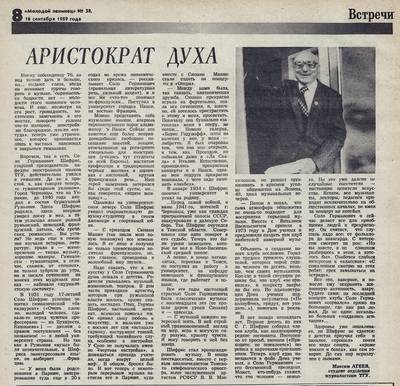
002. Aristocrat of the Spirit. Maxim Ageyev // Molodoy Leninets No. 38. September 16, 1989. The hero of the publication is Shifris Solo Germanovich
This article is a biographical essay dedicated to Solo Germanovich Shifris, a senior lecturer in the Department of Foreign Languages at Tomsk State University (TSU), and the founder and permanent president of the Chamber Music Lovers' Club at the House of Scientists in Tomsk.
The key stages of S. G. Shifris’s life are highlighted:
- Early life and education : Born and raised in Chernivtsi (in Romania until 1940), where he studied a variety of languages and humanities. He earned a bachelor's degree from the school in 1931.
- University education : Entered the University of Nancy, France, in 1931, where he graduated in January 1934.
- Musical education : Meeting Suzanne Mange in Nancy, who instilled in him a deep interest in classical music. The patronage of his father, Hermann Schifris, who supported artists and instilled in his son a love of art from childhood, is mentioned.
- Moving to Siberia and Career : Evacuation from Chernivtsi to Siberia in June 1941. Work as a German teacher at Novo-Vasyugansk Secondary School. From the late 1950s, he worked at Tomsk State University in the German and French Department.
- Social activities : In 1973, together with the principal cellist of the Tomsk Symphony Orchestra, V.V. Maximov, he founded the Chamber Music Lovers' Club at the House of Scientists, which became his main passion. The club, which had been operating for fifteen years at the time of publication, brings together true art connoisseurs.
The article emphasizes S. G. Shifris's active life position, his cheerfulness, ineradicable nobility, and desire to introduce people to beauty, including classical music and other forms of art.
List of mentioned persons:
- Ageev, Maxim - Student of the Department of Journalism at TSU, author of the article.
- Maksimov, V.V. (Vitaly Vasilyevich) - First cellist of the Tomsk Symphony Orchestra, Honored Artist of the RSFSR, co-founder of the Chamber Music Lovers Club.
- Mange, Suzanne - A female student, an acquaintance of S. G. Shifris at the University of Nancy, instilled in him a love for classical music.
- Shifris, German - The father of Solo Germanovich Shifris, a philanthropist, instilled in his son a love of art.
- Shifris, Solo Germanovich - Senior Lecturer, Department of Foreign Languages, Tomsk State University, founder and permanent president of the Chamber Music Lovers Club.
003. The Boys Against Marshal Stalin. Vitaly Azef // Molodoy Leninets, No. 38, September 16, 1989.
The article recounts how a group of Saratov schoolchildren founded the anti-Stalin "Organization of Young Revolutionaries" (OYUR) in the summer of 1943. The students were 12 and 13 years old. The organization consisted of approximately 20 members and had a program and anthem—"The Internationale."
According to the program, all Oyurovites were required to graduate from universities, join the party, strive for leadership positions, and work to expand the organization. The main goal was to overthrow Stalin by any means necessary and return to Lenin.
Schoolchildren prepared leaflets explaining the ideas of the OYuR program, posted them around the city, and placed them in mailboxes. The wording was something like: "Stalin destroyed Lenin's principles. And the OYuR's task is to restore them."
The organization lasted for three months.
By the decision of the Special Council, five people were convicted: Geliy Pavlov received six years, German Kulikov and Sigismund Schwartz received four years each, and Boris Anokhin and Svyatoslav Ilyin received three years each. All served their sentences in Tomsk's Juvenile Labor Colony No. 2.