Maslovsky Evgeny Alexandrovich (Archbishop Iuvenaly)
* * *
Archbishop Iuvenaly (Juvenaly), in the world Yevgeny Alexandrovich Maslovsky, was born on January 15 (27), 1878 in the city of Livny, Oryol province, in the family of a nobleman Alexander Maslovsky and his wife Anna. He graduated from the gymnasium, the Kazan Theological Academy (1903) with a degree in theology. On February 10, 1901, he was tonsured a monk. From February 25, 1901 - hierodeacon, from June 3, 1902 - hieromonk. Since 1903 - a member of the Urmian Spiritual Mission (in Persia). Since 1904 he has been a teacher at the Pskov Theological Seminary. From October 4, 1906 - rector of the cenobitic Spaso-Eleozarov monastery of the Pskov diocese; On October 6, Bishop Arseny (Stadnitsky) of Pskov was elevated to the rank of abbot. From October 23, 1910 - rector of the Novgorod Yuryevsky first-class monastery, on November 14 of the same year he was elevated to the rank of archimandrite.
By the highest command of July 29, 1914, he was appointed Bishop of Kashirsky, vicar of the Tula diocese (instead of Evdokim (Meshchersky). Consecrated bishop on August 24 of the same year in St. Petersburg. Arrived in Tula on September 9, 1914. From July 28, 1917 - Bishop of Tula and Belevsky. Member of the Local Council of the Cathedral 1917-191 8 years Bishop of Tula and Venevsky since 1919. Bishop of Tula and Odoevsky since 1920. An icon of the Mother of God was found on the bell tower of the Tula Holy Cross Church in 1922. A mass pilgrimage began to the church, continuous prayer singing was performed in front of the icon. Aliya, who was in prison for some time, but then was released.From October 17, 1923 - Archbishop of Kursk and Oboyansk.
In February 1924, he was arrested on charges of "anti-Soviet agitation" and sent to the Solovetsky Special Purpose Camp (SLON). Worked as a caretaker. Participated in the compilation of the "Solovki Epistle" of the bishops who were in the camp to the Soviet authorities, in which it was proposed to implement the principle of mutual non-interference of the state and the church in each other's affairs. In the conditions of the camp imprisonment, he began to work on the "Bishop's Solemn", which later amounted to three thousand pages (he knew the church charter perfectly and amazed his contemporaries with an exceptional memory for church hymns). He made an attempt to connect the practice of ancient Russian hierarchal services contained in the Officials of the Moscow Assumption Cathedral, the Kholmogory-Preobrazhensky Cathedral, the Nizhny Novgorod Preobrazhensky Cathedral and the Novgorod Sophia Cathedral with modern church practice, bringing various local features under uniform rules for all hierarchal services. The manuscript was lost in 1935 (it was with his friends for verification during reprinting and accidentally died in a fire).
He remained faithful to Metropolitan Sergius (Stragorodsky) after the publication of the "Declaration", which contained significant concessions to the Soviet government. At his request, he was released from the camp. In May 1928, Metropolitan Sergius sent Archbishop Iuvenaly to reach agreement with Metropolitan Agafangel of Yaroslavl, who had separated from him after the release of the Declaration. Vladyka succeeded in softening the conflict between the two metropolitans.
From April 27, 1928 - Archbishop of Ryazan and Zaraisk. From August 7, 1929 - Archbishop of Ryazan and Shatsky. He accepted into the diocese clergymen returning from exile, giving them parishes and helping them financially. In 1935, an arrested priest from the Starozhilovsky district, Hieromonk Anatoly (Kupryashkin), escaped from custody and hid in the archbishop's house for about a week, but was extradited by someone, arrested again and exiled. Hegumen Kirill (Zelenin), who returned from exile, was given a parish, and after the authorities expelled him for organizing a community of believers and working with youth, he also hid him, after some time sending him to a new parish. The experiences of Vladyka at the end of his stay at the Ryazan cathedra can be judged from the following words: “Life has become difficult, you can’t trust anyone, because you don’t know what kind of people you are surrounded by. People sell themselves and become agents of the GPU.”
On January 22, 1936, he was arrested, sent to Moscow (held in the Taganskaya and Butyrskaya prisons) and sentenced to five years in the camps. Accused of “being the organizer and inspirer of a counter-revolutionary group of clergy, monastics and churchmen, systematically made counter-revolutionary judgments with the clergy from among those arrested, gave counter-revolutionary instructions, in particular, about transferring the Church to an illegal position, personally served a solemn memorial service in the church for the former Russian Tsar Nicholas 2, delivered a counter-revolutionary speech in the church during his 20th birthday her, he also allowed the production of secret tonsures, recruited young students around the church ... ”(under the anniversary, he meant the 20th anniversary of the episcopal consecration, which took place back in 1934).
He was transferred to Siblag, where he arrived on July 15. Around this time, he wrote in one of his letters: “How I would like to share with you everything that I had to go through lately. How much edifying, comforting, gratifying, mystical. Hence I have both good spirits, and peace in my soul, and an awareness of how insignificant we are and how great is the power of God and His mercy to us. At every step, with all the difficulties and burdens, I see the hand of God, protecting, saving, comforting, caressing, amusing ... ".
He was sent to a camp in the village of Chistyunka at the Topchikha station of the Tomsk railway, then to a camp in the village of Voroshilovka. He worked as an accountant-card reader in the financial part, an accountant, in general work (ten hours a day), head of the pantry of a working tool, and a watchman. On June 30, 1937, for health reasons, he was transferred to the Tomsk invalid labor colony.
He was arrested and on October 13, 1937 by the Troika at the UNKVD in the Novosibirsk Region was sentenced to death. On the night of October 24-25, he was shot on Kashtachnaya Gora in Tomsk, where he was buried in a common grave.
Correspondence of the Ryazan teacher, parishioner of Archbishop Iuvenaly Anna Konstantinovna Arnoldi broke off with him in the summer of 1937. And for many years nothing could be learned about the further fate of Juvenal. Even in 1989, at the request of the Ryazan Archbishop Simon, the head of the Ryazan KGB Department of State Security, Chichelov, continued to hide the truth about the death of Iuvenaly: "... To serve his sentence, he was sent to Siblag (the city of Mariinsk, Kemerovo Region). We do not have information about the further fate of Maslovsky E. A. ".
Officially rehabilitated as politically repressed January 16, 1989.
Glorified in the Cathedral of the Ryazan Saints on June 23, 1992 by the Decree of His Holiness Patriarch Alexy II of Moscow and All Rus'. Ranked among the Holy New Martyrs and Confessors of Russia at the Jubilee Bishops' Council of the Russian Orthodox Church in August 2000 for general church veneration.
In Ryazan, the Fund of Hieromartyr Iuvenaly of Ryazan was established. On October 25, 2004, a solemn meeting dedicated to the memory of Hieromartyr Iuvenaly took place at the Ryazan Theater on the Cathedral.
In 2004, Metropolitan of Kursk and Rylsk Iuvenaly (Tarasov) retired and accepted the schema with the name of Hieromartyr Iuvenaly (Maslovsky), who served in the Kursk cathedra before his imprisonment in Solovki.
Rehabilitated.
Documents (2)
Fund 002 / Inventory 003: Статьи / Case 171
001. He became the first [Text] / V. A. Khanevich // Museum. - 2016. - pp. 34-39
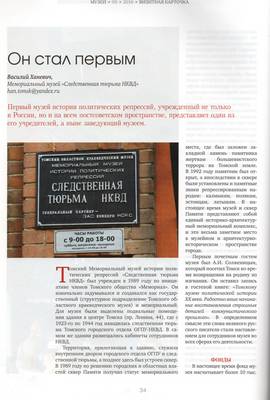
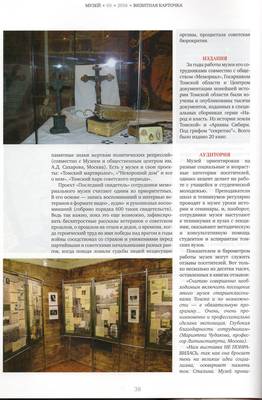
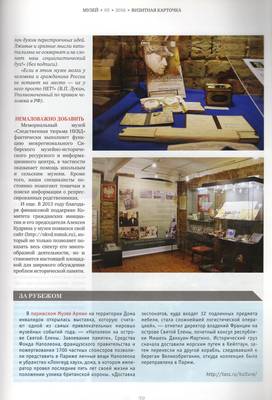
A review article about the Tomsk Memorial Museum of the History of Political Repression, "The NKVD Pre-Trial Prison." The museum was established in 1989 at the initiative of members of the Tomsk Memorial Society as a division of the Tomsk Regional Museum of Local History. It became the first museum dedicated to the history of political repression not only in Russia but also in the entire post-Soviet space.
The museum is located in the basement of a building in central Tomsk (44 Lenin Avenue), which housed the Tomsk City Department of the OGPU-NKVD pretrial detention facility from 1923 to 1944. Currently, the museum and the adjacent Memory Square, home to a monument to the victims of the Bolshevik terror, form a single historical and architectural memorial complex.
The publication describes in detail:
- The museum's collections contain more than 10,000 items and include an electronic database of nearly 200,000 victims of repression in the Tomsk region.
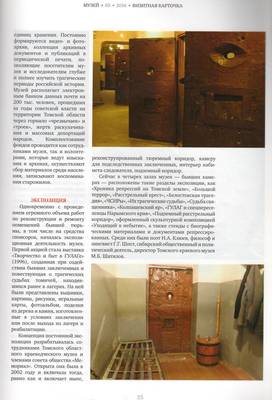
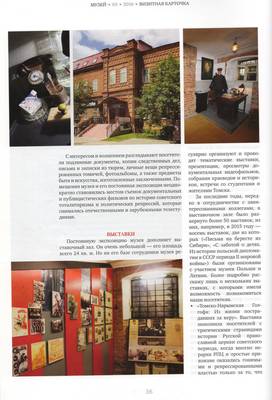
- Exhibition : The permanent exhibition opened in 2002 and includes a reconstructed prison corridor, a cell for defendants, an investigator's office, and an underground corridor. Sections of the exhibition are devoted to chronicles of repression, the Great Terror, the Gulag, special settlers of the Narym Territory, and biographies of those repressed, including the poet N.A. Klyuev and the philosopher G.G. Shpet.
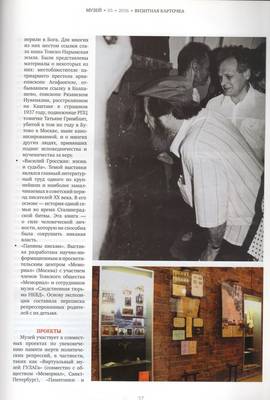
- Exhibition activities : Thematic exhibitions, presentations, and meetings are regularly held in the 24-square-meter exhibition hall. In 2015, for example, eight exhibitions were held, two of which were in collaboration with museums in Poland and Latvia. Special mention should be made of the exhibitions "Tomsk-Narym Golgotha: From the Lives of Those Who Suffered for Their Faith," "Vasily Grossman: Life and Fate," and "Papa's Letters."
- Projects and Publications : The museum participates in joint projects ("Virtual Gulag Museum," "Monuments and Memorials to Victims of Political Repression") and implements its own ("Tomsk Martyrology," "The Last Witness"). Museum staff have published 20 books in the series "People and Power. From the History of the Tomsk Land" and "Archives of Siberia. Classified."
- Audience : the focus of the work is on schoolchildren and students, for whom history lessons, seminars and lectures are held.
The museum serves as an interregional Siberian museum-historical resource and information center and actively works to perpetuate the memory of victims of political repression.
List of persons mentioned
- Agathangel, Archbishop and Locum Tenens of the Patriarchal Throne, who served his exile in Kolpashevo.
- Grimblit Tatyana was a Russian Orthodox Church ascetic from Tomsk who was killed in Butovo, Moscow, in 1937 and has now been canonized.
- Vasily Grossman is one of the greatest writers of the 20th century, the author of a literary work that became the subject of the exhibition.
- Juvenaly, Bishop of Ryazan, was a bishop who was shot at Kashtak in 1937.
- Klyuev N.A. is a poet, among those repressed, whose biographical materials are presented in the exhibition.
- Alexey Kudrin is the chairman of the Civil Initiatives Committee, whose financial support enabled the museum to launch its own website in 2013.
- Lukin V.P. - Human Rights Commissioner of the Russian Federation, who left a review in the museum's guest book.
- A.I. Solzhenitsyn was the first honorary guest of the museum to visit Tomsk during his return to his homeland from exile.
- Vasily Khanevich is one of the founders and, at the time of publication, the director of the Memorial Museum "NKVD Investigative Prison".
- Marietta Chudakova, professor at the Literary Institute (Moscow), left a review in the museum's guest book.
- Shatilov M.B. is a Siberian public and political figure, director of the Tomsk Regional Museum, and one of the repressed persons whose biographical materials are presented in the exhibition.
- Shpet G.G. is a philosopher and linguist, among those repressed, whose biographical materials are presented in the exhibition.
Fund 101 / Inventory 001. Томск. Каштак / Case 001: История захоронения
005. Vladimir Rodchenko. Holy Mount Kashtak. Tomsk Herald. 10/06/2001.
A newspaper article about how "cultured Tomsk sleeps in a graveyard". The history of the prison (transit lock - ITL-2 - pretrial detention center) on Pushkin Street and the history of executions are described.
The article mentions the names of those shot in Tomsk: poet Nikolai Klyuev, philosopher Gustav Shpet, Prince Alexander Golitsyn, holy martyr Juvenaly the Melodist, righteous Peter, Theodora and blessed Domna, Tomsk bishop Seraphim (Shamshev), princess Elizaveta Volkonskaya, princess Olga Urusova (Golitsyna), Prince Mikhail Dolgorukov, hieromonk Nikita Shirinsky-Shikhmatov, Tomsk local historian Alexander Adrianov, St. Petersburg writer Herbert Zukkau, Abbess Anastasia (Nekrasova), rector of the Resurrection Church Nikolai Chistoserdov.
On projects for the construction of a memorial church and chapel on Kashtak. A project for a chapel proposed to be built at the intersection of Ilmer Street and Mira Avenue is presented.
"It would be good to put a church at the crossroads - although a place on the southern edge of the park, at the entrance to Kashtak, would also be suitable, so that the domes could be seen from afar. Well, and around the church-monument in the future it would be possible to expand the memorial complex - for example, to put slabs with the names of the repressed. <...> I would like to believe that already this year an account for donations for the church will be opened, the foundation stone will be consecrated and the foundation will be laid. According to Orthodox tradition, the initiators of the construction themselves also suggested the name of the future church. Very symbolic, kind and beautiful - in the name of the Angel of Good Silence."
