Shpet Gustav Gustavovich
Born March 26, 1879 in Kyiv. Pole. Philosopher, aesthetician, ethnologist. In philosophy, a follower of the idealistic phenomenological school of Hussel. In 1898, he entered the Physics and Mathematics Department of St. Vladimir's University. In 1910, he was sent to the libraries of Berlin, Paris, and Edinburgh. Studied and worked at the University of Göttingen under Hussel, the founder of the modern philosophical problematics of phenomenology. In 1916, he defended his dissertation "History as a Subject of Logic." Professor of the Riga Women's Courses. In 1918, he became a professor at Moscow University in the History Department. On his initiative, a cabinet of ethnic psychology was opened. At Moscow State University, he founded the Institute of Scientific Philosophy and was its first director. Member of the Moscow Linguistic Society. Representative of the "Kievites" - an entire sector in Russian culture of the late 19th - early 20th centuries. 1923-1929 - Vice-President of the Russian, then State Academy of Art Sciences GAChN. Founder and Director of the Institute of Scientific Philosophy. Gave lectures at the Military Pedagogical Academy, knew 17 languages, was engaged in translations. 3 children. In 1927, after the purge of scientific personnel, he was deprived of the opportunity to engage in science. To earn money, he translates literary texts. Arrested in Moscow on the night of March 14, 1935. Charged under Art. 58-10, 58-11 of the Criminal Code of the RSFSR. Sentenced on June 20, 1935 by the Special Security Service of the NKVD of the USSR to 5 years of exile in Siberia. Until December 18, 1935, he served his exile in Yeniseisk. Struggled to be transferred to Tomsk. At the request of the actors of the Moscow Art Theater, he was transferred to Tomsk. Arrested on October 27, 1937 in Tomsk. He was executed on November 16, 1937, in Tomsk. He was rehabilitated in 1956 by the Tomsk Regional Court. On November 16, 1989, a memorial plaque was installed on the house where Shpet lived in Tomsk.
memorial.krsk.ru/martirol/sho_shr.htm
Documents (3)
Fund 002 / Inventory 003: Статьи / Case 171
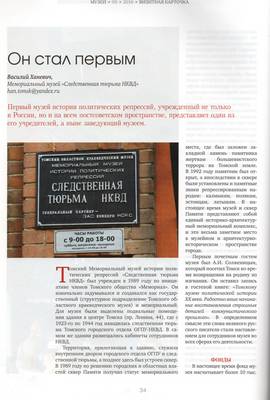
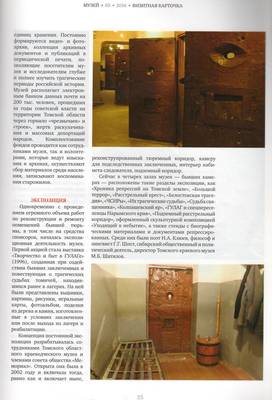
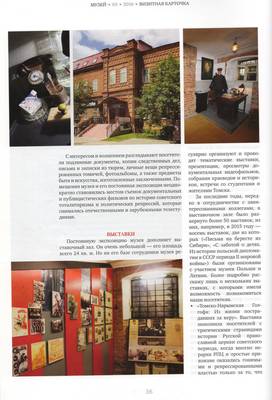
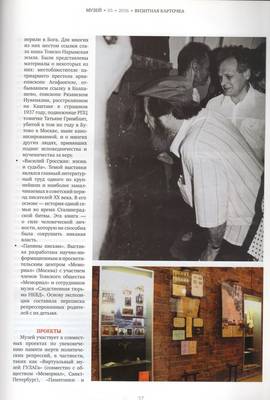
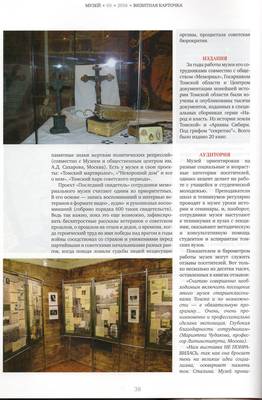
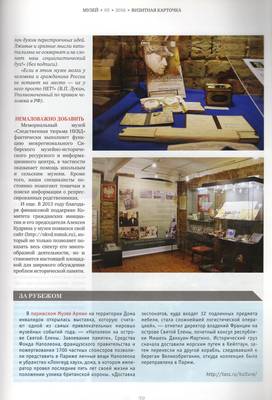
001. He became the first [Text] / V. A. Khanevich // Museum. - 2016. - pp. 34-39
A review article about the Tomsk Memorial Museum of the History of Political Repression, "The NKVD Pre-Trial Prison." The museum was established in 1989 at the initiative of members of the Tomsk Memorial Society as a division of the Tomsk Regional Museum of Local History. It became the first museum dedicated to the history of political repression not only in Russia but also in the entire post-Soviet space.
The museum is located in the basement of a building in central Tomsk (44 Lenin Avenue), which housed the Tomsk City Department of the OGPU-NKVD pretrial detention facility from 1923 to 1944. Currently, the museum and the adjacent Memory Square, home to a monument to the victims of the Bolshevik terror, form a single historical and architectural memorial complex.
The publication describes in detail:
- The museum's collections contain more than 10,000 items and include an electronic database of nearly 200,000 victims of repression in the Tomsk region.
- Exhibition : The permanent exhibition opened in 2002 and includes a reconstructed prison corridor, a cell for defendants, an investigator's office, and an underground corridor. Sections of the exhibition are devoted to chronicles of repression, the Great Terror, the Gulag, special settlers of the Narym Territory, and biographies of those repressed, including the poet N.A. Klyuev and the philosopher G.G. Shpet.
- Exhibition activities : Thematic exhibitions, presentations, and meetings are regularly held in the 24-square-meter exhibition hall. In 2015, for example, eight exhibitions were held, two of which were in collaboration with museums in Poland and Latvia. Special mention should be made of the exhibitions "Tomsk-Narym Golgotha: From the Lives of Those Who Suffered for Their Faith," "Vasily Grossman: Life and Fate," and "Papa's Letters."
- Projects and Publications : The museum participates in joint projects ("Virtual Gulag Museum," "Monuments and Memorials to Victims of Political Repression") and implements its own ("Tomsk Martyrology," "The Last Witness"). Museum staff have published 20 books in the series "People and Power. From the History of the Tomsk Land" and "Archives of Siberia. Classified."
- Audience : the focus of the work is on schoolchildren and students, for whom history lessons, seminars and lectures are held.
The museum serves as an interregional Siberian museum-historical resource and information center and actively works to perpetuate the memory of victims of political repression.
List of persons mentioned
- Agathangel, Archbishop and Locum Tenens of the Patriarchal Throne, who served his exile in Kolpashevo.
- Grimblit Tatyana was a Russian Orthodox Church ascetic from Tomsk who was killed in Butovo, Moscow, in 1937 and has now been canonized.
- Vasily Grossman is one of the greatest writers of the 20th century, the author of a literary work that became the subject of the exhibition.
- Juvenaly, Bishop of Ryazan, was a bishop who was shot at Kashtak in 1937.
- Klyuev N.A. is a poet, among those repressed, whose biographical materials are presented in the exhibition.
- Alexey Kudrin is the chairman of the Civil Initiatives Committee, whose financial support enabled the museum to launch its own website in 2013.
- Lukin V.P. - Human Rights Commissioner of the Russian Federation, who left a review in the museum's guest book.
- A.I. Solzhenitsyn was the first honorary guest of the museum to visit Tomsk during his return to his homeland from exile.
- Vasily Khanevich is one of the founders and, at the time of publication, the director of the Memorial Museum "NKVD Investigative Prison".
- Marietta Chudakova, professor at the Literary Institute (Moscow), left a review in the museum's guest book.
- Shatilov M.B. is a Siberian public and political figure, director of the Tomsk Regional Museum, and one of the repressed persons whose biographical materials are presented in the exhibition.
- Shpet G.G. is a philosopher and linguist, among those repressed, whose biographical materials are presented in the exhibition.
Fund 101 / Inventory 001. Томск. Каштак / Case 003: Поклонный крест
002. Press release of the Committee on Information Policy of the Tomsk Administration dated February 7, 2003
The press release informs about the upcoming opening of the Worship Cross on Kashtachnaya Gora, dedicated to the victims of Stalin's repressions. The idea of a memorial, including a cross, a chapel and a park, was initiated in the 90s and implemented by the efforts of the Tomsk city administration, with the support of public and religious figures. Kashtachnaya Gora, historically associated with tragic events, preserves the memory of thousands of those shot and buried. The memorial symbolizes memory, repentance, reminding people of the eternal.
List of names mentioned:
- Bishop of Tomsk and Asino Rostislav;
- Mayor of Tomsk Alexander Makarov;
- Poet Nikolai Klyuev;
- Philosopher Gustav Speth;
- Academician G.A. Ilyinsky;
- Prince Alexander Golitsyn;
- Prince Mikhail Dolgorukov;
- Princess Olga Urusova (Golitsyna);
- Saint Juvenaly, canonized in 1992.
Fund 101 / Inventory 001. Томск. Каштак / Case 001: История захоронения
005. Vladimir Rodchenko. Holy Mount Kashtak. Tomsk Herald. 10/06/2001.
A newspaper article about how "cultured Tomsk sleeps in a graveyard". The history of the prison (transit lock - ITL-2 - pretrial detention center) on Pushkin Street and the history of executions are described.
The article mentions the names of those shot in Tomsk: poet Nikolai Klyuev, philosopher Gustav Shpet, Prince Alexander Golitsyn, holy martyr Juvenaly the Melodist, righteous Peter, Theodora and blessed Domna, Tomsk bishop Seraphim (Shamshev), princess Elizaveta Volkonskaya, princess Olga Urusova (Golitsyna), Prince Mikhail Dolgorukov, hieromonk Nikita Shirinsky-Shikhmatov, Tomsk local historian Alexander Adrianov, St. Petersburg writer Herbert Zukkau, Abbess Anastasia (Nekrasova), rector of the Resurrection Church Nikolai Chistoserdov.
On projects for the construction of a memorial church and chapel on Kashtak. A project for a chapel proposed to be built at the intersection of Ilmer Street and Mira Avenue is presented.
"It would be good to put a church at the crossroads - although a place on the southern edge of the park, at the entrance to Kashtak, would also be suitable, so that the domes could be seen from afar. Well, and around the church-monument in the future it would be possible to expand the memorial complex - for example, to put slabs with the names of the repressed. <...> I would like to believe that already this year an account for donations for the church will be opened, the foundation stone will be consecrated and the foundation will be laid. According to Orthodox tradition, the initiators of the construction themselves also suggested the name of the future church. Very symbolic, kind and beautiful - in the name of the Angel of Good Silence."
